
C#: make one with the Geom.Nodes.Disc() factory, then set and read its properties
by name with Set and Get, or in the Inspector, where the node
is GeomDisc.
A disc, pie, ring or arc placed in 3D space.
From code
The code used to generate this page's thumbnail.
var disc := GeomDisc.new()
disc.rotation_degrees = Vector3(90, 0, 0)
disc.radius = 1.0
disc.color = EMBER
add_child(disc)
var disc = Geom.Nodes.Disc();
disc.RotationDegrees = new Vector3(90, 0, 0);
disc.Set("radius", 1.0f);
disc.Set("color", EMBER);
AddChild(disc);Properties
| float | angle_end_degrees | 270.0 |
| float | angle_start_degrees | 0.0 |
| bool | arc_end_cap_round | false |
| bool | billboard | false |
| BlendMode | blend_mode | Geom.BLEND_TRANSPARENTGeom.BlendMode.Transparent |
| Color | color | Color(1, 1, 1, 1) |
| GeomDash | dash | null |
| DiscType | disc_type | Geom.DISC_DISCGeom.DiscType.Disc |
| Resource | fill | null |
| float | radius | 0.5 |
| ThicknessSpace | radius_space | Geom.SPACE_WORLDGeom.ThicknessSpace.World |
| float | thickness | 0.05 |
| ThicknessSpace | thickness_space | Geom.SPACE_WORLDGeom.ThicknessSpace.World |
Enumerations
enum Geom.ThicknessSpace
- Geom.SPACE_WORLDGeom.ThicknessSpace.World = 0
- World units, the same as a node's
position. - Geom.SPACE_VIEWPORT_PIXELSGeom.ThicknessSpace.ViewportPixels = 1
- The viewport's pixels. Constant size on screen at any zoom.
- Geom.SPACE_VIEWPORT_PERCENTGeom.ThicknessSpace.ViewportPercent = 2
- Percent of the viewport's shorter side. Like CSS
vmin.
enum Geom.BlendMode
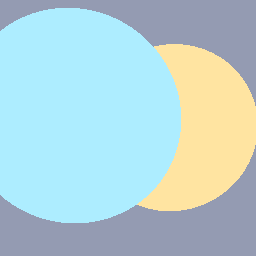
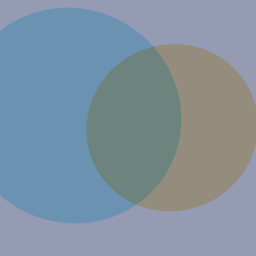
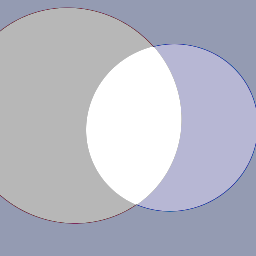
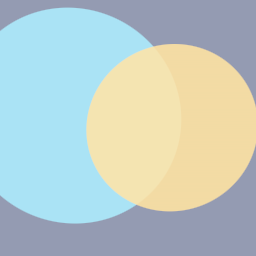
- Geom.BLEND_OPAQUEGeom.BlendMode.Opaque = 0
- Sorts by position. Hard edges: no anti-aliasing, and alpha is ignored.
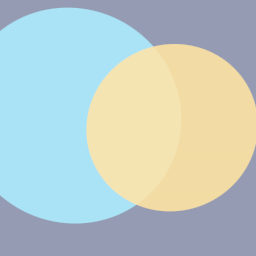
- Geom.BLEND_TRANSPARENTGeom.BlendMode.Transparent = 1
- Standard alpha blending. The default.
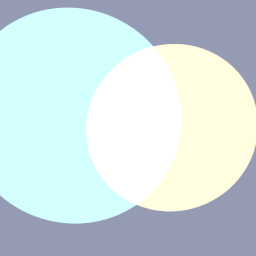
- Geom.BLEND_ADDITIVEGeom.BlendMode.Additive = 2
- Adds this color to what is behind.
- Geom.BLEND_MULTIPLYGeom.BlendMode.Multiply = 3
- Multiplies what is behind by this color.
- Geom.BLEND_SUBTRACTGeom.BlendMode.Subtract = 4
- Subtracts this color from the background.
- Geom.BLEND_TRANSPARENT_DEPTHGeom.BlendMode.TransparentDepth = 5
- Transparent, but writes depth, so shapes with alpha 1 sort by position with anti-aliased edges. A translucent color behaves like Transparent.
enum Geom.DiscType
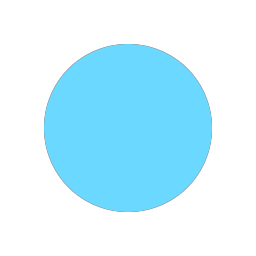
- Geom.DISC_DISCGeom.DiscType.Disc = 0
- Filled circle.
- Geom.DISC_PIEGeom.DiscType.Pie = 1
- Filled circular sector, bounded by the start and end angle.
- Geom.DISC_RINGGeom.DiscType.Ring = 2
- Hollow ring.
radiusis to the middle of the wall. - Geom.DISC_ARCGeom.DiscType.Arc = 3
- A section of a ring, bounded by the start and end angle.



Property descriptions
float angle_end_degrees = 270.0
Where a Pie or Arc ends. The sweep runs forward from the start and wraps, so 350 to 10 is a 20 degree arc.
float angle_start_degrees = 0.0
Where a Pie or Arc starts, in degrees counterclockwise from +X.
bool arc_end_cap_round = false
Round off an Arc's ends.
bool billboard = false
Always face the camera.
BlendMode blend_mode = Geom.BLEND_TRANSPARENTGeom.BlendMode.Transparent
How the shape blends with what is behind it.
Color color = Color(1, 1, 1, 1)
Fill color, or the outline's color when border is set.
GeomDash dash = null
A dash pattern.
DiscType disc_type = Geom.DISC_DISCGeom.DiscType.Disc
Disc, Pie, Ring or Arc.
Resource fill = null
A gradient in place of color. Takes GeomFillRadial, GeomFillAngular, GeomFillLinear or GeomFillCorners.
float radius = 0.5
Center to edge. For Ring and Arc, center to the middle of the wall.
ThicknessSpace radius_space = Geom.SPACE_WORLDGeom.ThicknessSpace.World
How radius is measured.
float thickness = 0.05
Wall thickness for Ring and Arc.
ThicknessSpace thickness_space = Geom.SPACE_WORLDGeom.ThicknessSpace.World
How thickness is measured.