
Languages
GDScript, C# and other GDExtensions.
geom is a GDExtension, so its classes are in ClassDB and every language Godot supports can access them.
Nodes
GeomDisc2D, GeomRect2D, GeomSphere and the rest are ordinary scene nodes
and work regardless of language. Add one to your scene, set its
properties in the Inspector, and it draws.
GDScript
The GeomDraw singleton and the enums are globals, and an enum name works as a type:
extends Node2D

func _process(_delta: float) -> void:
	GeomDraw.reset_all_draw_states()

	# Sizes and modes are named constants on Geom, not bare integers.
	GeomDraw.thickness_space = Geom.SPACE_VIEWPORT_PIXELS
	GeomDraw.thickness = 6.0
	GeomDraw.blend_mode = Geom.BLEND_ADDITIVE
	GeomDraw.disc_2d_colored(Vector2(100, 100), 40.0, Color(0.42, 0.85, 1.0))

	# The enum name is a type.
	var mode: Geom.BlendMode = Geom.BlendMode.BLEND_TRANSPARENT
	GeomDraw.blend_mode = mode
	GeomDraw.ring_2d_colored(Vector2(220, 100), 40.0, Color(1.0, 0.78, 0.36))

	# Any language can read the constants by name through ClassDB.
	var additive: int = ClassDB.class_get_integer_constant("Geom", "BLEND_ADDITIVE")
	GeomDraw.blend_mode = additive
	GeomDraw.disc_2d_colored(Vector2(340, 100), 40.0, Color(0.55, 0.98, 0.78))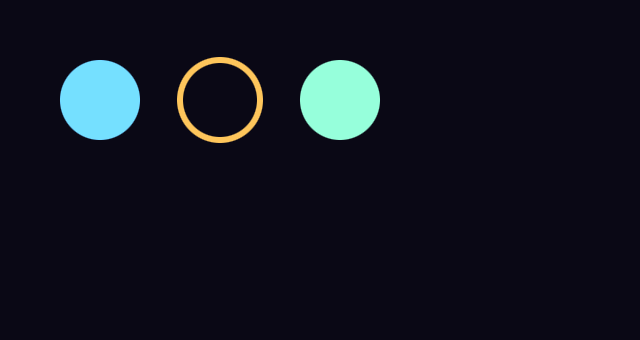
C#
Godot does not generate C# bindings for a GDExtension. The addon includes
addons/geom/cs/Geom.cs, which wraps the singleton and declares the enums as
C# enums. Godot.NET.Sdk compiles every .cs under the project, including
under addons/, so there is nothing to set up.
using Godot;

Geom.Draw.ResetAllDrawStates();
Geom.Draw.ThicknessSpace = Geom.ThicknessSpace.ViewportPixels;
Geom.Draw.Thickness = 6f;
Geom.Draw.BlendMode = Geom.BlendMode.Additive;
Geom.Draw.Disc2DColored(new Vector2(100, 100), 40f, Colors.Cyan);
Enum names don’t need prefixes in C#: Geom.BlendMode.Additive, not
BLEND_ADDITIVE.
An extension class cannot be constructed with new from C#, so nodes come
from factories. Their properties go through Set and Get:
var disc = Geom.Nodes.Disc2D();
disc.Set("radius", 40f);
AddChild(disc);
Bulk Calls
Every call from C# boxes its arguments into Variants and looks the method up by name. A thousand discs:
| one call per shape | one bulk call | |
|---|---|---|
| GDScript | 114µs | 71µs |
| C# | 936µs | 90µs |
Per shape, C# is eight times slower than GDScript. A bulk call crosses once for the whole batch, which is ten times faster from C# and level with GDScript.
var centers = new Vector2[4000];
// ... fill centers ...
Geom.Draw.Discs2D(centers, new float[] { 2f }, new Color[] { Colors.Cyan });
From C#, use the bulk calls wherever you can.
Other GDExtensions
There are no bindings for other languages. A Rust or C++ extension reaches geom through ClassDB:
let mut draw = Engine::singleton().get_singleton("GeomDraw").unwrap();
draw.call("disc_2d", &[Vector2::new(100.0, 100.0).to_variant(), 40.0.to_variant()]);
Constants are readable by name through
ClassDB.class_get_integer_constant("Geom", "BLEND_ADDITIVE"), as the
GDScript example above shows.
Summary
| Nodes in the editor | Typed drawing API | Typed enums | Fast bulk drawing | |
|---|---|---|---|---|
| GDScript | yes | yes | yes | yes |
| C# | yes | yes, via the shipped shim | yes, as C# enums | yes |
| Other GDExtensions | yes | no, dynamic calls | by name lookup | yes |